

Liquidity has always been fundamental to financial resilience, helping companies absorb a slowdown, cover unexpected costs, or ride out disruption. More and more, CFOs are thinking about liquidity in the context of growth, too.
In Webster Bank’s 2026 CFO Outlook report, balance sheet and liquidity optimization ranked as executives’ second-highest strategic priority for the year, rising in importance from 2025. The shift reflects a business environment where leaders are balancing economic uncertainty with continued ambitions for growth. An acquisition or investment opportunity may still make sense; having the capacity to act on it is becoming a bigger part of the calculation.
Most executives believe they are well prepared. Nearly 90% say they are very or somewhat confident in their ability to maintain liquidity through economic fluctuations. They point to strong cash reserves, consistent operating cash flow, established credit facilities, diversified revenue streams, and regular cash flow monitoring as the key drivers.
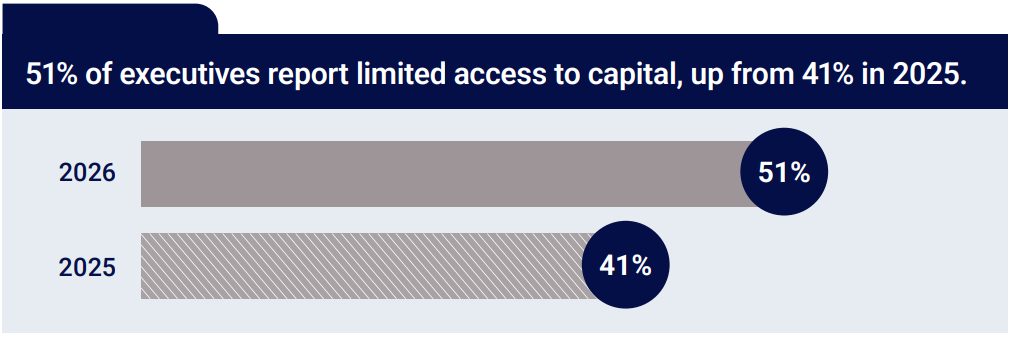
Yet another finding complicates the picture: 51% report limited access to capital, up from 41% in 2025.
The two findings aren’t necessarily contradictory. A company can have a healthy liquidity position today while recognizing that additional capital may be harder or more expensive to secure tomorrow. That distinction becomes important when companies are weighing acquisitions or investments that require funding beyond current cash flow.
Higher borrowing costs and tighter credit conditions are already affecting those decisions. More executives report delaying investments and postponing expansion plans because of capital market conditions. The economics of an opportunity may still work, but the margin for error has narrowed.
“You can get a bit myopic and not consider the broader implications of certain decisions. An outside perspective helps.”
Capital markets are only one source of pressure. Customer behavior is creating another. Four out of five executives are concerned that changing customer behavior could affect revenue stability. They’re seeing slower purchasing, greater price sensitivity, delayed purchases, less brand loyalty, and more volatile demand.

For CFOs, those behavioral changes eventually become balance sheet questions. Delayed purchases affect revenue forecasts. Slower payments extend receivable cycles. Volatile demand complicates inventory planning. Small changes in each can add up to meaningful pressure on working capital.
That makes forecasting especially important—and more difficult. Historical patterns become less reliable when the behavior behind them no longer holds.
The survey also points to a notable shift in how executives approach interest rate risk. The percentage focused on increasing liquidity and mitigating losses from rate changes more than doubled, from 12% in 2025 to 25% in 2026. Meanwhile, the share of executives focused on minimizing rate volatility fell from 31% to 18%.
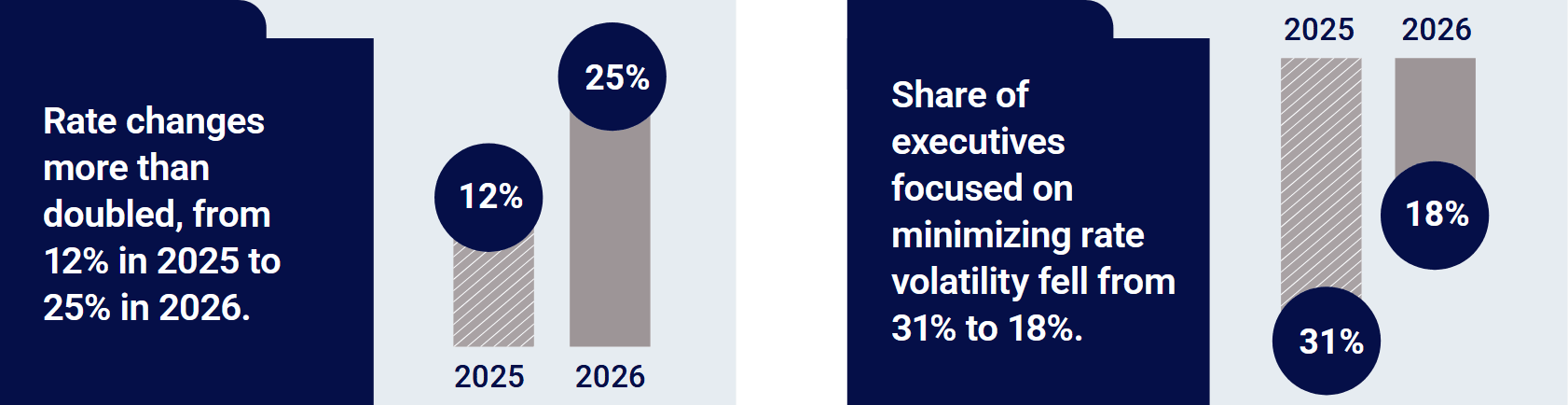
Taken together, those numbers suggest that CFOs are becoming less focused on insulating the business from every rate movement and more focused on preserving the capacity to respond as conditions evolve.
For executives pursuing growth, liquidity and strategy are increasingly intertwined. An acquisition opportunity, expansion plan, ownership transition, or major investment can create significant capital demands—often at a time not entirely of the company’s choosing.
That’s where the right banking relationship can add value beyond access to capital. An experienced advisor can help leaders evaluate working capital, assess financing capacity, structure credit, and understand the tradeoffs between deploying capital today and preserving capacity for tomorrow.
With the right strategy in place, companies have more room to absorb what they can’t predict—and more options when the right opportunity appears.
“It’s about having a professional double-check my decisions. That gives me real peace of mind in uncertain times.”
Find out how Webster Bank’s Commercial Banking advisors can help you strengthen liquidity, evaluate financing options, and prepare for your next strategic move.
The opinions and views herein are for informational purposes only and are not intended to provide specific advice or recommendations. Please consult professional advisors with regard to your situation.
All quotes are from survey participants.